Hello dear readers and followers, I now write for “Coffee House Writers” magazine on a fortnightly basis, and my poem “Hearing Is Out of Sight”, is in this week’s edition of Coffee House Writers Magazine. … please click on the link below and visit my poem, at Coffee House Writers. >> https://coffeehousewriters.com/hearing-is-out-of-sight/
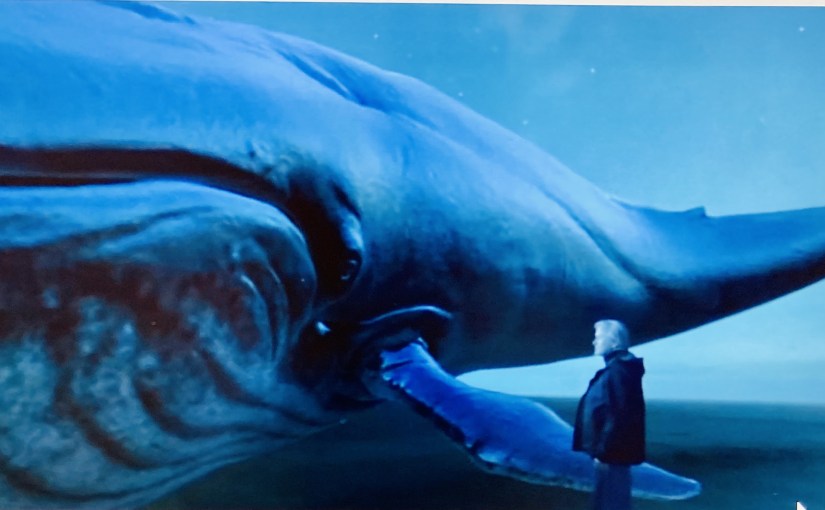
In those ignorant olden days Who would have wanted to be a whale? Who threw that harpoon into my back?
Whales Cry Too (a Mariannet*)
I
Hear them cry
…..When horrific harpoons pierce their hides
…..My heart bleeds from inside
……….Seeing whales so cruelly killed
The name “Mariannet” was recently ‘coined’ by Paul (of Paul’s Poetry Playground) >> [ Invented Poetry Forms – The Mariannet – Paul’s Poetry Playground ] for the previously unnamed poetic form that the poet Marianne Moore created to write her classic poem “The Fish” first published in 1918. The form was invented over a hundred years ago and is relatively unknown to most poets. The mariannet is an isosyllabic rhyming poem, consisting of one or more five-line stanzas (quintains) with one syllable in the first line, three in the second, nine in the third, six in the fourth, and eight in the fifth and final line. The first two lines rhyme with each other, and so does the third and fourth, but the fifth is nonrhyming and does not rhyme with any other lines. Thus its rhyme scheme can be expressed as aabbx for each individual quintain (with x representing the nonrhyming line). In Moore’s original formatting of the form, the third and fourth lines were indented five spaces and the fifth ten spaces. I have attached Marianne Moore’s poem “The Fish”, below Lisa Hannigan’s music/video.
“The Fish” – by Marianne Moore
wade through black jade. Of the crow-blue mussel-shells, one keeps adjusting the ash-heaps; opening and shutting itself like
an injured fan. The barnacles which encrust the side of the wave, cannot hide there for the submerged shafts of the
sun, split like spun glass, move themselves with spotlight swiftness into the crevices— in and out, illuminating
the turquoise sea of bodies. The water drives a wedge of iron through the iron edge of the cliff; whereupon the stars,
pink rice-grains, ink- bespattered jelly fish, crabs like green lilies, and submarine toadstools, slide each on the other.
All external marks of abuse are present on this defiant edifice— all the physical features of
ac- cident—lack of cornice, dynamite grooves, burns, and hatchet strokes, these things stand out on it; the chasm-side is
dead. Repeated evidence has proved that it can live on what can not revive its youth. The sea grows old in it.
G’day to my readers here on WordPress, I’m not feeling well, and I’ve not been my usual self in being able to comment on all of your wonderful posts. I’m off to China on Wednesday morning, doing a compact 10 day sight-seeing tour, including the Great Wall of China. Hopefully I’ll be feeling betterer by then. Here’s my poem for today. I’d like to thank Kate of “Calmkate’, for the use of her words, “rank dank muddy waters”, which were basically the inspiration behind my gloomy poem, “There’s a Crack In My China Soup Bowl”, and also thanks to “Stella”, for giving me the idea for the Title of this poem.
A poem from a previous bad back month, in December 2019, seems to be appropriate as I head into the second month of frustrating inactivity … Sorry, readers and followers for my continuing blogging absense …
Thank you to Ryan Stone for being the source of my inspiration behind the words in this Haiku. Visit Ryan’s fabulous site via this link >> https://daysofstone.wordpress.com
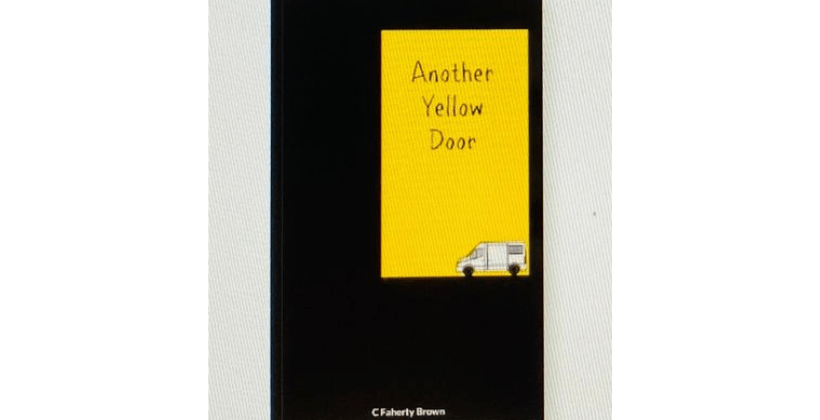
This weekend, on Weekly Prompts, the challenge word is:Review (2). Please go over and visit their fabulous site by clicking on >> Here. Below is my review of of C Faherty Brown’s new book “Another Yellow Door”, and you may visit her site via this link>> https://bikecolleenbrown.wordpress.com/
“Another Yellow Door” enticingly invites you to join Bronagh on her travel log of adventure across USA, via an “off the beaten track” journey. Bronagh has converted her purpose-bought cargo van into a self-contained home on wheels, which has a distinct side opening “Yellow Door”. The door on her van proves to be like a yellow honey hive, attracting various characters who are openly curious enough to enquire about Bronagh’s fascinating van and her journey’s adventures. Bronagh is brave, but not overly confident of what she wants to achieve, or the actual purpose of her quest. She doesn’t know where she is traveling to, or why she is traveling in that direction … No Matter, jump aboard, sit in the empty passenger seat and enjoy the ride. You won’t be disappointed with where ever her journey happens to take you, and you’ll be more than enchanted with whoever she meets along the way. There were times I smiled with tears of joy and sometimes I cried tears of sadness … and overall I thoroughly enjoyed reading “another” fabulous book by C Faherty Brown
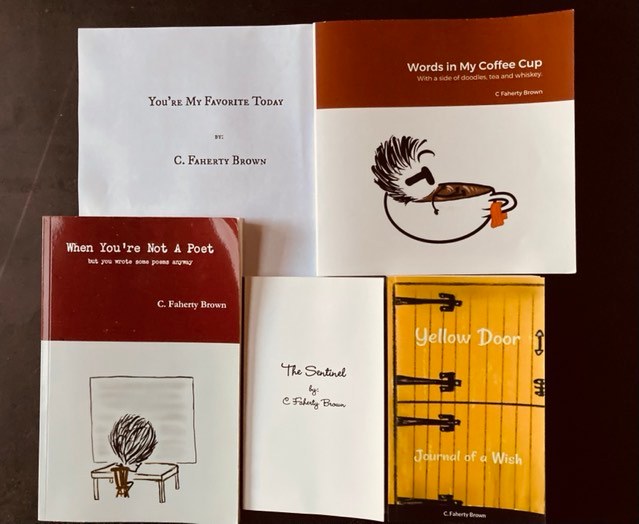
My collection of Colleen’s fabulous
I think Colleen has the same number of books as “Leonard Cohen” in my bookcase.
Hello dear readers and followers, I now write for “Coffee House Writers” magazine on a fortnightly basis, and my poem “A Good Guide”, is in this week’s edition of Coffee House Writers Magazine. … please click on the link below to read my poem, at Coffee House Writers. >> https://coffeehousewriters.com/a-good-guide/
Hi dear readers, I’ve found another poem that is in my files, but does not appear on my Website … now I am wondering what happened to my website entries between the 16th and 19th of October last year … it’s a mystery to me??







 Ivor.Plumber/Poet